Lilypie Kids Birthday tickers
Lilypie First Birthday tickers
Lilypie Breastfeeding tickers
Showing posts with label Teaching English. Show all posts

8/02/2012

Sensory bags for the kids!

I decided to make sensory bags for my kids, with little Alex in mind in particular as I'd like to introduce him to more types of sensory play. 

A sensory bag is basically made up of stuff you put in a bag that won't burst the bag (read: no sharp objects) and yet offers some sensory play for the child. So basically anything goes as long as it doesn't break the bag (e.g. gel, liquid soap, shaving cream, embellishments, buttons etc.). 

Little Alex has played with his leftover food (yes, I let him play with only the leftovers - after all, it's all gonna be thrown away so I might as well let him have a go at it) and he loves to crush cauliflower - somehow he thinks that it isn't food because he never tries to mouth the florets which I give him for finger food. He always crushes the florets and has this look of glee when the florets are in bits and pieces in his palms. Babies.

Since sensory bags can offer safe sensory play for babies, I decided why not?

So I got down to making them for my kids.

Here's the math themed sensory bag for my girl. This was too small a baggie and I have since transferred the stuff into a bigger bag so that we can play I Spy with her. Too small a bag means that all the items are squashed together and it's difficult to play the game.


Items that went in my math themed sensory bag:
  • gel sticker numbers
  • heart-shaped beads
  • some sequins
  • glitter
  • liquid handsoap
  • food colouring


And here's the all things bright and sparkly bag for the baby boy:


Items that went in this bag:
  • liquid handsoap
  • lots of glitter
  • lots of different shaped sequins and embellishments

Remember to tape up the sensory bags to prevent leaking and supervise your children at all times as little teeth and sharp fingernails could pierce the bags.


I added colouring to one of the bags the next day and my girl realised to her delight that she could practise her handwriting! :)

Simply use your fingertips to 'write' on the sensory bag! Here she practised her Chinese strokes but she also happily practised writing alphabets. So wonderful to find another use for my sensory bags since she's not so into squishing the bags!


If you have a preschooler who's learning to write, or if you've a little baby and you want to introduce safe sensory play, give this a try!

I'm gonna try to make a shaving cream sensory bag as well as a water beads sensory bag too... when I get my hands on the materials... :)

Do share your sensory bags on my Facebook page if you make some! 

*edited on 3/8/2010:
Please try to use freezer bags as they are thicker and have a double zip instead of a single one. Mine kept leaking after awhile as I was using normal storage bags.

8/15/2011

Activities to go with The very hungry caterpillar by Eric Carle

It's been quite awhile since I've found time and energy to blog... this is such an overdue post!

The good thing though is that The very hungry caterpillar is a classic so it's never too late to share what we did for the reading of this story.

I made this learning aid from here:


There are a couple of missing pieces though but it still works rather fine.

I got her to match the pieces to what she could see on the pages to practise counting:


and instead of a 'story stick' (which is how the learning aid is supposed to be made), I gave her a piece of yarn for her to thread the pieces together, following the sequence of the story:


And so it's killing two birds with one stone: getting her to practise fine motor skills as well as learning to sequence according to the story line. She did really well with the sequencing after awhile such that by the time she watched the performance put up by Act 3 in mid July, she could tell exactly what was coming up next :)


After threading all the cards, just tie a ribbon and she gets a necklace - which made the vain little one very happy. This activity can be done over and over again - something that your preschooler would request to do!

And we chose a day to make egg carton caterpillars:


My girl loves all things small and cute so instead of making 3 long caterpillars, we had 5 short ones. 


Painting the egg carton was quite a highlight as it was a new experience.

After the paint has dried, just draw and cut out eyes for the caterpillars (or use googly eyes), draw a smile, pierce two holes at the top of the caterpillars' heads (to be done by an adult) and poke the pipe cleaners in.
Do you notice that there's one female caterpillar? :) 
Hint: the one with the eyelashes

We made a symmetrical painting by first folding a piece of drawing block in half then squeezing paint randomly on it. Once that is done, press the drawing block together and you will get a symmetrical painting. After you have done the first fold, you can unfold it and press the other side of the drawing block together and repeat the process. :)


After the paint has dried, draw a butterfly and cut it out:


We did this counting activity which you can download here:


Alicia wasn't very interested in this activity compared to the rest of the activities but you can always give it a shot. 

Another activity that might interest your preschooler would be these two dot-to-dot printables which you can download here.

We took the chance to revise the Days of the Week using the learning aid my mum made for her earlier (I made the Mandarin version):


Have fun!

7/20/2011

Activities to go with The mixed-up chameleon by Eric Carle


The mixed-up chameleon is a colourful and playful story about how a chameleon wishes to be someone else only to find out that what's best for him is really to just be himself. 

We also didn't do many activities for this story as I was trying to minimise the preparation of activities. I don't really have the time and energy to make extensive learning aids for her, and since the new baby will be arriving in about 3 months time, I have decided that we will maximise learning opportunities with minimal preparation on my part - I imagine that I should be busier with the arrival of the new baby! That said, I have implemented a more proper structure for our homeschooling recently (will share that in a later post) to make things more organised for both her learning and my planning.

(i) Colour revision


Well, it's a colourful book like I said and the chameleon on the cover is just begging you to name the colours you see! Alicia enjoyed naming the colours, even without my prompting... naming the colours in Mandarin is the difficult part for her as she refuses to answer my questions in Mandarin... *sigh*

(ii) Catch a 'fly'
adapted from here (you can find other activities from the link but those may require a lot more preparation on your part. Some of the activities are also too simple for Alicia already so I only picked what I thought would work best for us)

You need:

  • a party blower (see pic below)
  • a small piece of velcro (the hard side)
  • small pieces of felt (to simulate the fly)


The chameleon in the story loves to eat flies but I was too lazy to make a fly manipulative so I just gave her whatever small piece of felt I had on hand for this activity. It's probably quite difficult for a child to imagine how the long tongue of the chameleon works, so I think this is an interesting activity to illustrate how the chameleon catches the fly with its tongue (though it is not really exactly the same).


(iii) Make your own colourful chameleon

ok, I got this idea from somewhere but I can't remember where exactly... can't seem to find the link.

Anyway, you need:
  • colourful plastic dividers (I recycled the old ones which were lying around waiting for an opportunity to be recycled)
  • transparencies (the type used for Overhead projectors in the past) - trace the pics of the chameleon from Eric Carle's book
  • marker
  • scissors


happily playing with the cut up colourful dividers - her first encounter with them

Place the transparencies of the pictures of the chameleon around the house and get your preschooler to find them:


Can you see it? :P

Alicia loved to place the transparencies on different surfaces and kept asking me each time, "Mummy, where's the chameleon?"

To make your colourful chameleon, just randomly place the dividers on a flat surface and place the transparency of the pic of the chameleon on top.


It's a different chameleon every time and it can be done over and over again! :)


(iv) Writing practice


Discuss what the chameleon wanted to be in the story with your preschooler and ask her what she wants to be.

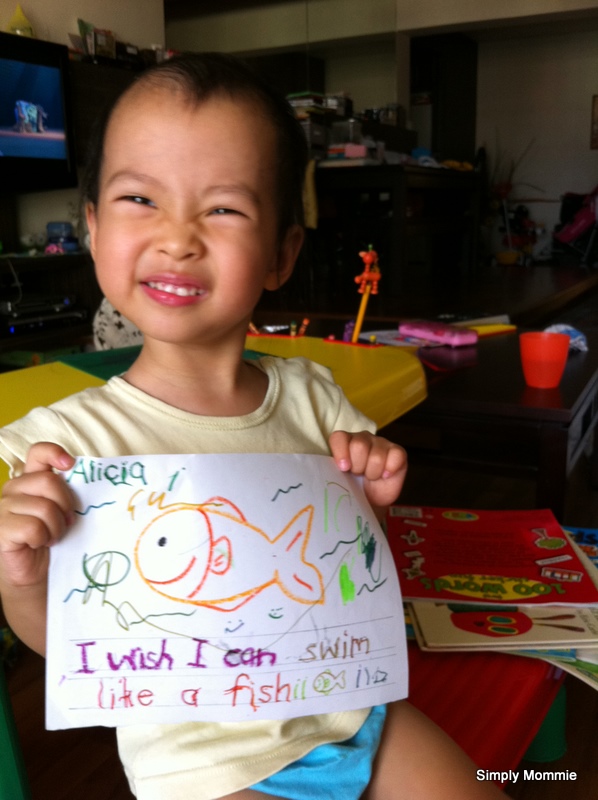
The little ardent swimmer that Alicia is, she naturally chose the fish. :)

As she is still unable to draw a proper fish, I drew a simple one for her. We then wrote a simple sentence about it. (I wrote the sentence for her, and she used a marker to trace the words for writing practice). We had to split this activity up into two sessions (conducted on different days) as she was unwilling to finish the sentence in one sitting.


(v) Art and craft fish + shape matching + writing practice (Mandarin)

Cut out some shapes to form a picture (I chose a fish since it tied in nicely with the above activity). 

Trace the exact shapes onto a sheet of paper to form the picture.

Get the child to place the shapes correctly on the paper first before sticking.

Get your preschooler to stick the shapes on.


Write the word you want your preschooler to trace and let her use a marker to write the word. Guide your child to write in the correct sequence of strokes if writing the chinese word. Name the strokes in Mandarin as you guide your child and get her to say the word when it's completed. 

*You can always adapt this activity to make your child practise writing in English or other languages.


1/31/2011

Activities to go with Mister Seahorse by Eric Carle

I think you already know I like Eric Carle's books... so Mister Seahorse should come as no surprise. :P Actually, Mister Seahorse wasn't in the list of the books I wanted to borrow but I always make it a point to hop over to the CAR section of the library to see if there are any appropriate Eric Carle books for Alicia. I was not disappointed that day as I found a spanking new copy of Mister Seahorse! :)


We did a few activities after reading this book - Alicia really loved the activities! Ironically, she loved the activities more than the book itself. She had fun though with the pages where some of the fishes were camouflaged (Eric Carle used transparencies for some pages so that you could turn the page and see the fish hiding behind). 

Here are the activities we did!:

(i) seahorse counting (and spelling of the number word)


I printed 12 seahorses (the exact pic of Eric Carle's seahorses), laminated them then cut them and trimmed the edges and made just enough alphabets (lower case) needed to spell 1-12 (one number only at any one time). The numbers are from the apple tree learning aid I made earlier and the cloth alphabets (in upper case) are from the Spelling Bee.

I velcro-ed all the parts so that they would stick nicely to the felt should I decide to hang up the piece of the felt as a felt board (felt measuring 64cmx64cm was obtained from the thrift store Daiso - here I folded it into about half its size).


We'd count the seahorses together then place the correct number on the felt.

Next, I'd place either the lower or upper case alphabets on the felt to spell the word and she would find the matching alphabets and place them below/above the alphabets that are used to guide her to spelling the number word. (This part of the activity helps with reinforcing matching upper and lower case alphabets and learning the spelling of the number word)


To further extend this activity to incorporate learning of Mandarin, you could get your tot to match the number to the Mandarin word (those with the Mandarin add-on counting cards for the apple tree learning aid could whip those out - kids get bored counting the same stuff all the time so seahorses could possibly break the monotony of counting apples!)

If you don't have time to make this learning aid, you can try this free resource which is slightly different but still teaches spelling of the number word.

We sang this rhyme (you could sing it as you do the counting activity shown above or sing it at any other time!):

Print out the rhyme here.
The seahorse was drawn by me and coloured by Alicia


(ii) Matching the numeral to the number word

I printed out this free resource from here and got Alicia to do the colouring of the seahorses - which she enjoyed thoroughly!

After printing out the pictures, I glued them onto a cereal box before cutting them out and letting Alicia doodle.


To encourage her to do the matching, I coloured the outline of the boxes with the words and she could choose the colours (we did it one number at a time so she could focus on the spelling of the word - I'd read out the alphabets which spell the word before and during the colouring of the outline of the box). After the colouring's done, she would place the seahorse on the correct box.

I also used phonics to guide her to finding the right word sometimes - e.g. pronouncing the /f/ sound so that she could narrow down her guesses to 'four' and 'five'.


Snapshots of the busy artist:


Doing the matching:

We further decorated the base sheet with paint - she's so good at painting... she really avoided painting inside the boxes! :P So proud of her! (the crayon marks inside the boxes were made before I told her not to colour inside the boxes)


(iii) Art (and Science) - exploring how colours blend together

Just as Eric Carle created his paintings for Mister Seahorse via tissue paper collage, I decided to try out this art activity using kitchen paper towels and food colouring.


Alicia posing with the materials

Mix 1 drop of food colouring with some water and place them in shallow dishes so that it's easier to get hold of the colours during the activity.
(You should try out with one sheet of kitchen towel before conducting this activity with your preschooler to have an idea of how it goes)

Fold the kitchen towel into half, then halve it again to make a square, then dip one corner or side into any dish:


Then dip it in another dish using another side/corner:


Repeat the step with the last colour:


Watch how the colours blend together and discuss what colours your tot sees and how different colours blend to make more colours (e.g. blue and yellow make green).

You can fold your kitchen towel into different shapes - for variety and also for teaching/ reinforcing shapes with your tot:

Alicia made a total of 4 pieces! (The fifth one was my experiment before conducting the activity):


Hanging on the grill to dry!

The dried pieces of art:

Some other activities you could consider doing with your tot can be found from this link.

I decided that it's time to move on to the next book - Corduroy by Don Freeman. :)

1/27/2011

Activities to go with Goodnight Moon by Margaret Wise Brown

Margaret Wise Brown's Goodnight Moon is a book that even very young children can easily relate to - a little bunny in his great green room saying goodnight to all the things around him. It is a classic bedtime book, with simple, soothing rhyme and rhythm.


The illustrations are in my opinion quite noteworthy. When the writer wants to focus on the room, bright colours are used and when focusing on details, such as the picture of the cow jumping over the moon, the illustrations are in black and white. Furthermore, as the story progresses, you will (or might) notice the green room darkening slowly. The time shown on the clock changes too as you turn the page and the quirky little mouse changes its position - Alicia loves to spot the mouse! :P The bunny changes his position in bed, the kittens take the place of the old lady on the rocking chair... 

Here are a couple of activities we did after reading the book:

(i) finding all the items mentioned in the book in the house (as far as possible)

Here's Alicia with her mittens!

You can see that she's really very pleased with the activity :P


A snapshot of but a few things we gathered - we had plenty more! :)

Getting the child to find physical objects or related objects to those mentioned in the book is a simple activity that the tot will gladly participate in. It allows the learner to be active in making the connections with what she sees on the page and what she has in her surroundings, not to mention that it's great for kinaesthetic learners!

After gathering all the items, read the story to the child again and when the item is mentioned, get the child to pick it out from the stash you probably have on the floor. :)

(ii) This is an activity that I found from here.

I decided to save printer ink and drew the pictures myself, together with Alicia.  I realise that she finds it more engaging to watch and guess what mummy is drawing next. So what I did was to draw the pictures on a piece of paper (bearing in mind the size of the pocket chart), paste it on a cereal box then cut out the individual cards - and they're done! :) 

I bought a pocket chart from Daiso last year and it's come in handy for this activity. :)


This activity is more for teaching word recognition - which will take a while and lots of revision! :)

(Alicia has already recognised the word "Goodnight" due to the frequent appearance of the word) 

You can remove either the picture or the word (leave "Goodnight" alone) and get your preschooler to fill in the blank with the right card.

Do not attempt to do too many words at a time. (I have a total of 15 words, focus on maybe 3-4 at a time)


(iii) Revise the rhyme "Hey Diddle Diddle" - that's where the cow jumped over the moon! :)


Other activities you can consider:

  • Hiding a favourite toy or a toy mouse and getting the child to look for it (similar to spotting the mouse in the book)
  • Incorporating the "Goodnight ___" phrase to your kid's bedtime routine.
  • Add a twist to the phrase: say "Good Morning ____" instead when your child wakes - if you aren't in a rush!
That's what we did for Goodnight Moon! Stay tuned for activities for Mister Seahorse by Eric Carle! :)


1/24/2011

Matching upper and lower case (with stickers)

Alicia chanced upon some stickers a few days back and insisted she wanted to stick them somewhere. Since she was intent on using the stickers, I decided that I should not just let the stickers go to waste... hence this on-the-spot activity! :P

It's a simple activity that anyone can do up and it requires little preparation so it's great for parents strapped for time. :) I first came across a similar activity at Activity Mom so when Alicia asked to play with stickers, I immediately decided that it was time to try this activity out with her.

All you need:
  • a piece of paper - preferably not in the colour of any of the stickers you're using (I used a scrap piece of construction paper :) )
  • markers
  • pen
  • liquid paper or silver pen (optional - for writing on dark coloured stickers (I didn't have it on hand, if not I'd have used it))
  • labelling stickers

Simply write the upper/ lower case letters on the paper and draw a circle around each alphabet and write a set of alphabets (upper/lower case) on the stickers. Here I wrote the upper case on the paper and the lower case on the stickers but you can choose to do it the other way round. It really depends on what your focus is.

The extra marks on the paper are Alicia's doodles - she wanted to draw on the paper when she saw me writing!

Get your tot to pick out any letter on the paper then look for the matching alphabet on the stickers. (That's a lot simpler than looking for the alphabet on the paper since the letters are all mixed up!)


 Stick it on!

The next two photos were taken by Alicia! I thought they captured quite a nice angle of the materials we used for the activity though they were a bit blurry....


Well, it's normal that your tot can't sit through all 26 letters! The activity can always be revisited and completed over a few days! :)

LinkWithin

Related Posts Plugin for WordPress, Blogger...